


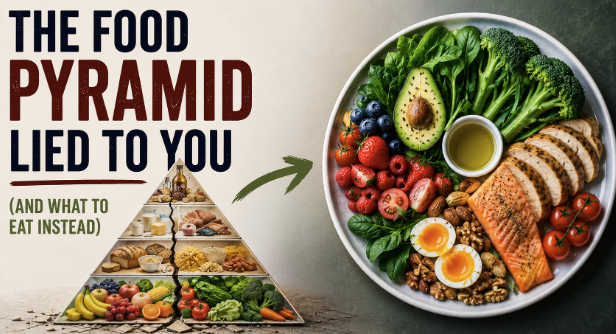
Most people who grew up in the United States learned the food pyramid in elementary school. Bread and grains at the base, the widest section, representing the foods you should eat most. Fat at the top, the narrowest point, to be avoided or severely limited. Dairy was in there as a given, recommended daily.
That pyramid shaped decades of eating habits. It also coincided with an explosion in metabolic disease, obesity, and diabetes.
The 2026 updated dietary guidelines inverted the original design. Protein, healthy fats, and vegetables now occupy the wide top. Grains sit at the narrow base. Alcohol was removed entirely. Ultra-processed foods and added sugars are explicitly discouraged.
It took decades to get here. And the updated version still has problems.
What the Old Pyramid Got Wrong
The grain-heavy base of the original food pyramid was not built on solid nutrition science. It was built, in part, on food industry lobbying and a set of assumptions about dietary fat that turned out to be backwards.
The low-fat craze that followed is a case study in how dietary policy can go wrong at scale. “Low fat” became the marker of a healthy product. Food manufacturers stripped fat from products and replaced it with sugar to compensate for the lost flavor. The products kept getting called healthy. Metabolic disease kept climbing.
Margarine is the clearest example. For years, it was marketed as the healthier choice over butter. It was produced industrially, containing partially hydrogenated oils. Real butter, a natural fat that humans had been eating for thousands of years, was the villain. Margarine was practically fake butter, created in a factory to substitute for the real thing.
That inversion, natural food bad, industrially produced food good, ran through a generation of dietary advice.
The current protein trend shows signs of the same pattern. Protein matters. It genuinely does. But now the word “protein” gets slapped on cereal, flavored milk, and ultra-processed bars, and people buy those products because a legitimate nutritional message got hijacked by marketing.
What the Updated Pyramid Still Gets Wrong
Dairy at the top of the 2026 pyramid is worth questioning.
Humans are the only species on the planet that consumes another animal’s milk past infancy. From a physiological standpoint, the enzyme needed to break down dairy decreases progressively after infancy. The body was not designed to digest it long-term. For many people, it causes irritation and inflammation.
Chronic skin conditions like eczema, psoriasis, and cystic acne are commonly linked to dairy consumption. Pulmonary mucus, autoimmune conditions, and various inflammatory processes show up repeatedly in the research alongside dairy intake. Not for everyone. But for a significant enough portion of the population that dairy should be evaluated individually rather than recommended universally.
Oranges appear near the top of the updated pyramid, pictured alongside strawberries and blueberries. An orange is essentially liquid sugar. High on the glycemic index, meaning it spikes blood sugar significantly when eaten alone. Berries, strawberry, blueberry, blackberry, raspberry, are the lowest glycemic fruits and the highest in nutrients per serving. Treating all fruit the same is nutritionally incorrect.
The pyramid is better than what came before. It is not a complete guide.
Protein: The Non-Negotiable Foundation
Every meal needs protein. Not just some meals. Not a high-protein snack occasionally. Every meal, at every age, for any person.
The target is 20 to 30 grams of protein per meal. That’s the threshold at which protein actually does its job: regulating hormones, supporting muscle development, improving satiety, and making skin health measurable over time.
Cereal is not a meal. Granola is not a meal. Toast is not a meal. These foods don’t contain sufficient protein or nutrient density to function as meals. They’re caloric with minimal metabolic value.
This is not a hard standard to meet. An egg contains around 6 grams of protein and is arguably the most nutritionally complete food available. It contains all essential vitamins, nutrients, and amino acids. The fear around eggs and cholesterol is not supported by current science, and the advice to cut eggs because of cholesterol concerns has been increasingly contradicted by research.
Two eggs with a side of greens is a better breakfast than almost any packaged cereal with “protein” on the box.
The Coffee Problem Nobody Warned You About
Coffee doesn’t appear on the food pyramid. It’s on a lot of Americans’ daily intake though.
Here is the problem: most popular coffee is heavily contaminated with mycotoxins. The coffee bean grows close to the ground, collects water, and accumulates significant mold during the growing and storage process. This is true even of organic coffee, because the mold contamination comes from the growing process, not the soil itself.
Drinking moldy coffee daily is not the same as drinking coffee. It’s a low-grade ongoing mold exposure that adds to the total inflammatory burden in the body. Switching to mold-free coffee brands, specifically ones produced with different harvesting and storage methods, addresses this without eliminating coffee. Those brands tend to cost more. For daily coffee drinkers, it’s a meaningful change.
Fruit, Fat, and Blood Sugar
Fruit is food. But not all fruit is equivalent, and when you eat it matters.
Berries are the best choice for most people. They’re nutrient-dense, low on the glycemic index, and won’t spike blood sugar significantly on their own. Apples, pears, and especially oranges are considerably higher on the glycemic index and should be treated more carefully
Pairing fruit with fat changes the metabolic outcome. Eating a piece of fruit alongside a meal that contains olive oil, avocado, eggs, or salmon slows blood sugar absorption. The fat blunts the spike. Eating fruit alone, especially high-glycemic fruit, produces the spike without the buffer.
This is why “fruit is healthy” is an incomplete statement. The type of fruit and what you eat alongside it matters as much as whether you’re eating it.
What to Actually Eat
Real food. This sounds vague until you apply one simple rule: if it wouldn’t exist in the wild, if it couldn’t rot, if it was assembled in a factory from ingredients you wouldn’t buy to cook with, it’s probably not food in a meaningful sense.
Protein at every meal. Eggs, quality meat, fish, legumes. The source matters less than making sure the meal contains enough.
Fat from real sources. Olive oil, avocado, fatty fish. Not margarine. Not seed oils.
Vegetables with variety. Leafy greens provide calcium without requiring dairy. Different colored vegetables cover different nutrient ranges.
Fruit chosen thoughtfully. Berries first. Moderate amounts. Paired with fat when possible
Grains minimized or absent for most people. This doesn’t mean never. It means they shouldn’t form the base of every meal.
The Visit That Never Happened
A patient came in for weight loss and fatigue. The intake question about diet revealed she was eating toast for breakfast every day. She was confident about the toast. She’d been eating that way for years and couldn’t understand why her energy was terrible.
Nobody had ever asked her what she ate for breakfast. Nobody had explained what 30 grams of protein per meal means in practice, or why toast doesn’t come close. That’s not a failure on her part. It’s a failure of the care she’d received.
Food conversations are not part of a standard five-minute visit. That’s a structural problem, not a personal one. But it means that most people are navigating nutrition without any real guidance, relying on packaging claims and decades-old advice that was often wrong to begin with.
The food pyramid was a starting point. The 2026 update is closer to right. What actually works is more specific than any pyramid can capture. Your body, your gut microbiome, your food sensitivities, and your life circumstances all shape what eating well looks like for you specifically.
That’s worth a real conversation with someone who has the time and training to have it.
About the Author: This article was written by the clinical education team at Med Matrix, a functional medicine clinic in South Portland, Maine. Med Matrix serves over 3,000 patients with a provider team that specializes in root-cause testing, hormone optimization, and personalized treatment plans.